

Investment Outlook: 2025 recap & 2026 outlook
Financial Advice
12-12-2025
Investment Outlook: 2025 recap & 2026 outlook
SHARE
As at 12 December 2025
Charting a course beyond uncertainty.
Highlights
After a dramatically volatile 2025, we expect some moderation in 2026. We chart a course for economies in 2026 that includes some knowns, with a plan to manage portfolios through, and beyond, uncertainty for the longer term.
- The investment outlook for 2026 is a reduced level of market volatility, generally supportive for equities, with some ongoing uncertainty due to various factors.
- Economies are settling down into mid-cycle growth with GDP normalizing and inflation up slightly, early in 2026.
- Policy settings will be influenced by local election cycles and national government security priorities but look broadly positive for stocks.
- Equities are starting from higher-than-average valuation, but we expect growth of earnings to be supportive.
- We see more opportunities in offshore equities due to better company fundamentals.
- Bonds reflect pressures from higher inflation, normalising central bank policy, and pricing out recession.
- The AUD is more favoured than the USD mainly due to positive interest rate differentials.
- Commodities overall are positive due to a combination of mid-cycle demand, mine supply shortages, and national minerals security.
- Gold is expected to remain well supported through 2026.
Introduction
The investment outlook for 2026 is shaped by a complex interplay of macroeconomic forces, political developments, and evolving market dynamics. In the sections below, we will delve deeper into the key themes, risks, and opportunities set to influence portfolios in the year ahead, drawing on insights from the evolution of our views in the past year and our assessment of the year ahead.
Economic backdrop and policy developments
In 2025, markets contended with significant political and economic friction, particularly between the United States and China. This culminated in the "Liberation Day" tariff announcements in April, which initially rattled markets. However, political pragmatism ultimately prevailed, with a partial rollback of the most severe tariffs. Throughout the year, additional policy shifts, including tariff reversals and adjustments, continued to create market volatility. Alongside these political events, concerns of a bubble in AI-related stocks emerged, signalling both enthusiasm and risk within the technology sector.
By the end of 2025 and moving into 2026, the global economic landscape is beginning to normalise. Major economies such as Australia, the US, and others are stabilising, but divergences in growth rates and inflation exist, influenced by local policy actions and broader global security concerns. Military, energy, supply chain, AI primacy, and manufacturing security have become central pillars of policymaking. Inflation is expected to tick up in the first half of 2026 before settling at a "new normal" level, higher than pre-pandemic averages.
Market scenarios for 2026
- Base case: Global equity markets are expected to be moderately volatile in 2026 with growing support that may propel equities to a high by the end of 2026. We expect bonds to track a sideways path as the US and other countries cut rates, and Australia may be on hold. We expect fewer political disruptions as US policy makers create a strong environment leading up to the US mid-term elections. Geopolitical tensions are likely to ease, while recession fears continue to fade. A balance between AI-induced positives and negatives further supports markets.
- Positive scenario: Resilient consumers and corporates, strong savings, and low leverage result in more confidence to spend. AI-driven productivity gains and continued government stimulus (notably in the US) reduce cost pressures and inflation may rise but remains controlled. This provides a supportive environment for equities and risk assets with moderate rises in bond yields (i.e., bond prices fall).
- Negative scenario: Persistent US inflation above 3% could slow the pace of Fed rate cuts, risking stagflation. More consistently, rising global bond yields and reduced demand for US Treasuries could create volatility and force central bank intervention. In Europe, rising defence and infrastructure spending necessitates greater debt issuance, adding upward pressure to global yields and shifting capital flows.
Long-term themes
- Geopolitical and policy volatility is an enduring feature of the landscape and must be incorporated into investment strategies.
- Climate change costs are rising, particularly due to energy-intensive data centres and AI applications.
- ESG investing is losing momentum, with a decline in the application of ESG labels.
- High government debt poses challenges for refinancing and financial stability.
- Accelerating technology adoption (AI, blockchain, hyperscale data) is reshaping industries and markets.
- Thematic investment strategies are prone to cycles of over- and undervaluation.
- Younger generations are challenging established institutions in an increasingly polarised society.
- Central banks are increasing gold reserves as a strategic response to rising government debt and concerns over fiat currency stability.
Current insights that link to the long-term
- The AI bubble fears that triggered a short-lived correction in equities, crypto and gold were reversed with a change in Federal Reserve narrative, which pivoted from possible on hold to rate cuts for December.
Regional Economies and Markets

United States: The US economy appears to be moving out of a soft patch, with labour market pressures easing and inflation trending back toward target, reducing the immediacy of recession risks. The Federal Reserve is now signaling an easing bias, with rate cuts underway and expected through 2026, supporting valuations even as equity markets become more dependent on earnings delivery rather than multiple expansion.
Australia: Domestic growth is gradually improving, supported by better business conditions and improving consumer sentiment, although a mild pickup in inflation is emerging as activity firms. The Reserve Bank of Australia has shifted to a more neutral stance after an extended hiking cycle, and the combination of stabilising rates and softer earnings momentum relative to global peers argues for maintaining a tactical tilt toward offshore equity markets over local shares.
Europe: Growth remains subdued but positive as the energy shock fades, with inflation converging towards central bank targets and fiscal policy only modestly supportive; recession risk is contained but trend growth stays low. European bond yields have likely peaked with scope for a gentle long bond yield decline as policy shifts from tightening to a prolonged pause or gradual easing, while equities should benefit from lower real rates but remain sensitive to earnings revisions and political risk.
China: The economy is expected to grow at a moderate mid‑single‑digit pace, underpinned by exports, targeted stimulus and a managed downshift from the old property‑led model, with policymakers focused on stabilising domestic demand and local‑government finances. Chinese asset markets should remain policy‑led, with government bond yields anchored by cautious easing, a managed‑flexibility approach to the renminbi, and equity leadership concentrated in policy‑favoured areas such as advanced manufacturing and green technology.
Japan: Growth is improving as real wages and domestic demand recover, while inflation hovers around the Bank of Japan’s target, allowing a careful exit from the ultra‑easy policy regime without derailing activity. Japanese markets are navigating a gradual normalisation path, with a slow grind higher in government bond yields, a structurally firmer yen over the medium term, and equities balancing support from better nominal growth against sensitivity to the pace of policy tightening.
Tactical Asset Allocation
|
Factor |
Rationale |
|
Fundamental – Moderately Positive |
Leading indicators in the US and Australia signal economic recovery. Earnings growth is re‑accelerating, policy settings are easier, and fiscal stimulus continues. Equity market fundamentals are stronger internationally than in Australia. Credit markets are solid, labour markets are softening but not weakening materially, and monetary aggregates are rising. These conditions are supportive for equities and risk assets. |
|
Valuation – Moderately Negative |
Equity valuations are stretched after recent rallies, but the risk of an earnings collapse is receding. Ongoing earnings growth is expected to help equities "grow into" their valuations, with positive Q3 company updates providing reassurance. Valuations remain a short-term headwind but are less concerning than earlier in the year. |
|
Technical – Neutral |
Strong technical momentum has followed tariff-related and AI bubble-related disruptions. Credit spreads have narrowed, and market sentiment among retail investors has moderated. Technical indicators are balanced, though seasonal volatility remains a factor. |
|
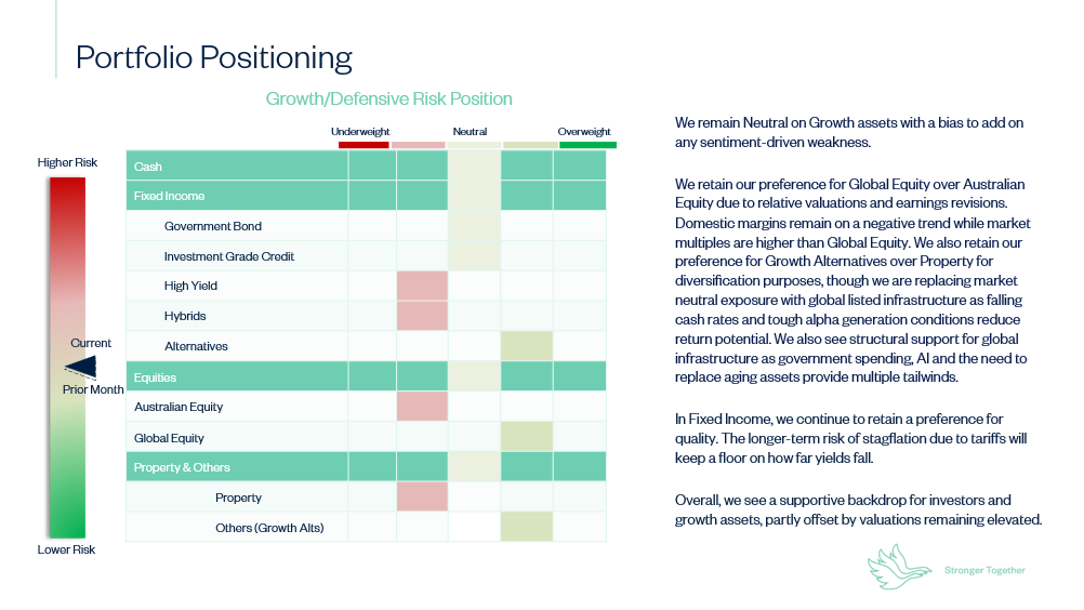
Overall view for growth asset classes. |
Overall, the environment is supportive for growth assets, given improving fundamentals and fading recession fears. While valuations are elevated, neutral tactical allocations are advised, with a readiness to add to risk positions should seasonal volatility provide opportunities. |
Conclusion
2026 is poised to be a year of mid-cycle economic growth, portfolio realignment, and ongoing adaptation to technological, political, and geopolitical change. Investors should remain vigilant, balancing opportunities for growth with prudent risk management, while keeping a close eye on policy shifts, market valuations, and macroeconomic signals.
This article contains information that is general in nature. It does not take into account the objectives, financial situation or needs of any particular person. You need to consider your financial situation and needs before making any decisions based on this information. This investment update has been prepared by Partners Wealth Group Investments Pty Ltd (ABN: 162 823 083, AFSL 483842) as Investment Manager.